A lesson is not a collection of nice activities. It is not a buffet where you casually throw in a lead-in, a worksheet, a video, a game, a role-play and a “quick discussion” because they all look delicious. A lesson is a sequence of purposeful stages that work together to help learners achieve a clear aim.
In other words, lesson planning is not just about asking:
What activities shall I use?
It is about asking:
In what order should these activities happen so that learning actually takes place?
This is where sequencing becomes essential. A good lesson sequence creates a logical journey. Each stage prepares learners for the next one. Each task has a reason. Each activity contributes to the main aim. Without this, the lesson can feel like an episode of a British sitcom: entertaining, unpredictable, and full of chaos — but not necessarily educational. Computer says no.
Why Sequencing Matters
Sequencing means putting lesson stages in a logical order so that learners are gradually prepared to achieve the main lesson aim.
Good sequencing helps learners move from easier to more challenging tasks, from support to independence, and from understanding to use.
Poor sequencing does the opposite. It can confuse learners, waste time, and make even a good activity ineffective.
For example, asking learners to write a formal complaint email before they have seen a model, analysed useful language, or understood the situation is like asking someone to assemble IKEA furniture without the instructions. Technically possible, but emotionally damaging.
A well-sequenced lesson gives learners the support they need at the right time.
Activities Are Not Random: They Need a Job
Every stage in a lesson should have a clear purpose.
A stage might:
- create interest in the topic;
- prepare learners for a text;
- expose learners to target language;
- clarify meaning, form and pronunciation;
- provide controlled practice;
- develop fluency;
- give learners feedback;
- prepare learners for a productive task.
If you cannot explain why a stage is there, it may not need to be there. “Because it is fun” is not enough. Fun is welcome, of course. We are teachers, not prison guards. But an activity should be both engaging and pedagogically useful.
A good question to ask while planning is:
How does this stage help learners achieve the main aim?
If the answer is unclear, the activity may need to go. Yes, even if you found it on Pinterest. I know. Painful.
Sequencing a Language Focus Lesson
A language focus lesson usually focuses on grammar, vocabulary, functional language or pronunciation. The main aim is normally for learners to understand and use a specific piece of language more accurately and appropriately.
There are different ways to sequence a language lesson. One common and effective framework is:
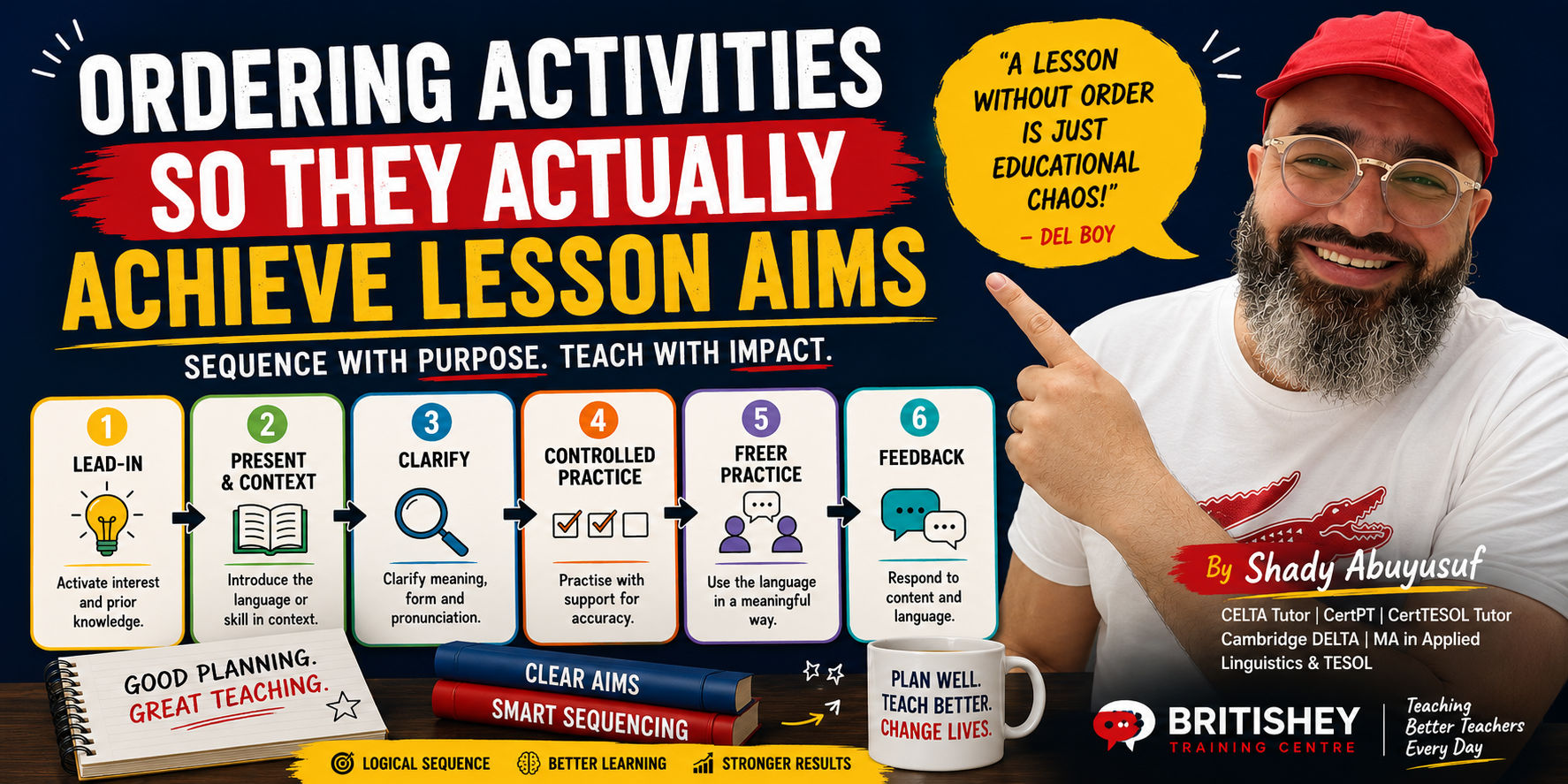
Lead-in → Context → Language Clarification → Controlled Practice → Freer Practice → Feedback
This is not the only possible sequence, but it is a useful one, especially for trainee teachers.
Let’s look at each stage.
1. Lead-in: Generate Interest and Activate Schemata
The lead-in introduces the topic or situation of the lesson. It should be short, engaging and relevant.
For example, if the lesson is on going to for future plans, the lead-in might involve learners briefly discussing their weekend plans.
The lead-in should not become a 20-minute therapy session about everyone’s life ambitions. Keep it focused. Its job is to warm learners up and lead them towards the context.
Aims achieved? Not yet. But the learners are now mentally entering the world of the lesson.
2. Context: Give the Language a Reason to Exist
Language does not live in isolation. It needs a context.
If you are teaching used to, learners need a situation where people talk about past habits or past states.
For example:
“When I was a child, I used to play football in the street. I didn’t use to have a mobile phone.”
The context helps learners understand why the target language is being used. Without context, grammar can become a dead museum exhibit: technically interesting, but nobody wants to spend the whole afternoon there.
A clear context helps learners connect form with meaning and use.
3. Language Clarification: Meaning, Form and Pronunciation
This is where learners understand the target language more deeply.
For grammar or functional language, you usually clarify:
Meaning: What does it mean? When do we use it?
Form: How is it constructed?
Pronunciation: How does it sound in natural speech?
For vocabulary, you may clarify meaning, form, pronunciation, word class, collocation, connotation and appropriacy.
For example, in a lesson on making polite requests, learners need to understand the difference between:
Open the window.
Can you open the window?
Could you possibly open the window?
They also need to know which forms are more direct, more polite or more appropriate in different contexts.
This stage supports the main aim by giving learners the tools they need before practice.
Skipping clarification and jumping straight to production is like giving someone a microphone and saying, “Now sing opera.” Brave? Yes. Sensible? Not really.
4. Controlled Practice: Build Accuracy
Controlled practice allows learners to practise the target language with support. The answers are usually limited or predictable.
Examples include:
- gap-fill exercises;
- matching forms to meanings;
- sentence transformation;
- choosing the correct option;
- drilling;
- substitution practice.
Controlled practice helps learners process the language accurately before they are expected to use it more freely.
For example, after clarifying comparatives, learners might complete sentences such as:
Cairo is ______ than Damietta.
This book is ______ than that one.
This gives learners a safe space to practise form and meaning before they move into freer communication.
Controlled practice is not the final destination. It is the training wheels.
5. Freer Practice: Move Towards Communication
Freer practice gives learners a chance to use the target language in a more meaningful way.
For example, in a lesson on should/shouldn’t for advice, learners might discuss problems and give advice:
I can’t sleep well.
You should avoid coffee at night.
You shouldn’t use your phone before bed.
This stage is usually where the main aim is most clearly achieved because learners are using the language communicatively.
If your main aim says learners will be better able to use the target language, they need an opportunity to use it. A lesson that ends after controlled practice is often incomplete. It is like building a car and never taking it out of the garage.
Lovely car. Shame nobody drove it.
6. Feedback: Respond to Content and Language
Feedback helps close the lesson loop.
In freer practice, feedback should usually include:
Content feedback: responding to what learners said.
Language feedback: dealing with useful language, errors or improvements.
For example, after a speaking task, you might briefly ask learners about their partner’s advice, then board examples of good language and errors for delayed correction.
Feedback should connect back to the aim. If the aim was using polite requests, feedback should focus partly on how successfully learners used polite request forms.
Feedback is not just “Good job, everyone.” That is nice, but it is not enough. It is the teaching equivalent of patting a broken washing machine and saying, “Bless it.”
Example: Language Focus Lesson Sequence
Main aim:
By the end of the lesson, learners will be better able to use should and shouldn’t to give advice about common health problems.
Possible sequence:
Lead-in: Learners discuss common health problems such as headaches, stress and tiredness.
Context: Learners read or listen to a short dialogue where one person gives advice to a friend.
Clarification: Teacher clarifies meaning, form and pronunciation of should/shouldn’t.
Controlled practice: Learners complete sentences using should or shouldn’t.
Freer practice: Learners role-play giving advice for different problems.
Feedback: Teacher gives content feedback, then delayed language feedback focusing on advice forms.
This sequence works because learners are gradually moved from topic awareness to language understanding, then from controlled use to freer use.
Sequencing a Skills Lesson
A skills lesson focuses mainly on reading, listening, speaking or writing.
For receptive skills lessons, such as reading and listening, a common sequence is:
Lead-in → Pre-teach essential vocabulary → Gist task → Detailed task → Response task → Feedback
For productive skills lessons, such as speaking or writing, the sequence may look different:
Lead-in → Model/Input → Useful Language → Planning → Speaking/Writing Task → Feedback
Let’s look first at receptive skills.
Sequencing a Reading or Listening Lesson
A reading or listening lesson should not begin with: “Open your books and read.” That is not a lesson sequence. That is a teacher surrendering to the photocopier.
A good receptive skills lesson prepares learners before the text, gives them a reason to read or listen, and then develops appropriate subskills.
1. Lead-in: Prepare Learners for the Topic
The lead-in introduces the topic and activates learners’ background knowledge.
If the text is about unusual jobs, learners might discuss interesting or strange jobs they know.
The lead-in should create interest and prepare learners for the content of the text. Again, keep it short. The lead-in is the starter, not the wedding buffet.
2. Pre-teach Essential Vocabulary
Pre-teaching vocabulary can help learners access the text, but it should be selective.
Do not pre-teach every difficult word. Learners do not need every single word to complete a gist task. If you pre-teach half the text before they read it, you have not prepared them; you have quietly murdered the reading lesson.
Pre-teach only words that are:
- essential for understanding the main idea or task;
- impossible to guess from context;
- likely to block comprehension.
For example, before a listening text about job interviews, you might pre-teach candidate, qualification and experience if they are central to the task.
3. Gist Task: Understand the Main Idea
A gist task gives learners a general reason to read or listen.
For example:
Read the article quickly. Which title is best?
Or:
Listen and choose the main reason why the speaker changed jobs.
The gist task should be achievable without understanding every detail. It trains learners to process the text globally.
Do not start with detailed comprehension questions. That is like asking someone to count the raisins in a cake before they know it is a cake.
4. Detailed Task: Focus on Specific Information or Deeper Understanding
After learners understand the general meaning, they can read or listen again for more detail.
Tasks might include:
- true/false questions;
- answering comprehension questions;
- completing notes;
- matching speakers to opinions;
- identifying attitudes;
- sequencing events.
This stage develops more careful reading or listening.
The important point is that the detailed task should come after the gist task. Global understanding first, detailed understanding second. Otherwise, learners may panic and try to understand every word from the beginning.
And we do not want panic. We want learning. Preferably with breathing.
5. Response Task: Personalise the Topic
After comprehension work, learners should respond to the text.
For example:
Do you agree with the writer?
Would you like to do this job?
Have you ever had a similar experience?
This stage gives the text a communicative purpose. It also allows speaking practice, but remember: in a reading or listening lesson, this is usually a subsidiary aim unless the lesson is designed as an integrated skills lesson.
The response task should not take over the lesson unless speaking is the main aim. Know your aim. Guard your aim. Protect it like the last piece of basbousa at a family gathering.
Example: Reading Lesson Sequence
Main aim:
By the end of the lesson, learners will be better able to read a short article about online learning for gist and specific information.
Subsidiary aim:
Learners will practise speaking by giving their opinions about online learning.
Possible sequence:
Lead-in: Learners discuss advantages and disadvantages of online learning.
Pre-teach vocabulary: Teacher clarifies three essential words from the article.
Gist task: Learners read quickly and choose the best summary of the article.
Detailed task: Learners read again and answer specific information questions.
Response task: Learners discuss whether they prefer online or face-to-face learning.
Feedback: Teacher checks task answers and gives brief language feedback from the discussion.
This sequence helps the lesson aim because learners practise reading in a staged way: first globally, then more carefully.
Sequencing a Speaking Lesson
A speaking lesson needs more than simply saying, “Now discuss.” Learners need preparation, useful language and a clear task.
A possible sequence is:
Lead-in → Model/Input → Useful Language → Preparation → Speaking Task → Feedback
1. Lead-in
Introduce the topic and get learners interested.
If the speaking task is about giving opinions on social media, learners might first discuss which apps they use most and why.
2. Model or Input
Learners may need exposure to the type of speaking they are going to do. This could be a short dialogue, video, audio clip or teacher-provided model.
For example, before learners debate a topic, they might hear examples of people agreeing, disagreeing and giving reasons.
3. Useful Language
Learners often need language support before speaking. This may include phrases for:
- giving opinions;
- agreeing and disagreeing;
- asking follow-up questions;
- interrupting politely;
- clarifying meaning;
- giving reasons.
For example:
I see your point, but...
I’m not sure I agree.
From my point of view...
What makes you say that?
This stage helps learners speak more effectively and confidently.
4. Preparation
Give learners time to think and prepare. This is especially important for lower-level learners or complex tasks.
Preparation might include making notes, choosing ideas, planning arguments or rehearsing with a partner.
Without preparation time, some learners freeze. Then the speaking task becomes less “communicative fluency” and more “silent suffering.” Not ideal.
5. Speaking Task
This is the main productive stage. Learners use the language and ideas they have prepared.
Make sure the task has a clear communicative purpose. Instead of saying:
Talk about travel.
Say:
In groups, choose the best holiday destination for a family with two children and explain your choice.
A clear outcome makes speaking more focused.
6. Feedback
After speaking, respond to content first, then language.
You might ask:
Which destination did your group choose? Why?
Then provide delayed feedback on useful language, errors or pronunciation.
The feedback should help learners notice how effectively they communicated and how they can improve.
Sequencing a Writing Lesson
A writing lesson also needs careful staging. A possible sequence is:
Lead-in → Model Text → Analysis of Features → Useful Language → Planning → Writing → Feedback
For example, if learners are writing an informal email, they should probably see and analyse an example before writing their own.
They may need to notice:
- layout;
- greeting and closing;
- paragraph organisation;
- useful phrases;
- tone and level of formality.
Then they plan, write and receive feedback.
Asking learners to write without preparation is not teaching writing. It is simply watching people write. There is a difference. A big one.
How to Know If Your Sequence Works
A good lesson sequence should feel logical. It should have progression.
Ask yourself:
Does each stage prepare learners for the next stage?
Does the lesson move from easier to more challenging work?
Does the lesson move from support to independence?
Does every stage contribute to the main aim?
Is there enough practice for learners to achieve the aim?
If your main aim is speaking fluency, but learners only speak for three minutes at the end, the sequence is probably not serving the aim.
If your main aim is grammar accuracy, but you never clarify form or provide controlled practice, there is a problem.
If your main aim is reading for gist and detail, but learners spend most of the lesson discussing the topic and barely reading, the lesson has wandered off like Uncle Albert telling war stories.
During the war... we had clearer stage aims.
Common Sequencing Problems
One common problem is starting with the hardest task. For example, asking learners to speak freely before they have the necessary language. This can lead to frustration and limited output.
Another problem is overloading the early stages. Some teachers spend too long on the lead-in, pre-teaching or clarification, leaving little time for the main practice. Remember, the main aim needs classroom time. It cannot survive on leftovers.
A third problem is including activities that do not connect. A song, a grammar exercise and a discussion may all be useful individually, but if they do not support the same aim, the lesson becomes fragmented.
Finally, some lessons stop too early. If learners understand the language but never use it, the aim has not been fully achieved. If learners read the text but never complete a meaningful comprehension task, the skill has not been properly developed.
Final Thoughts
Ordering activities is one of the most important parts of lesson planning. A strong sequence helps learners move step by step towards the lesson aim. It creates logic, support and progression.
For a language focus lesson, learners usually need context, clarification and practice. They need to understand the language, practise it accurately, and then use it more freely.
For a skills lesson, learners need preparation, purposeful tasks and a logical movement from general understanding to more detailed work, or from input and support to successful production.
A good lesson is not a pile of activities. It is a carefully organised learning journey.
So, before you add that extra game, video, worksheet or “quick discussion,” ask yourself:
What is this stage doing for the aim?
If it helps learners get closer to the aim, keep it.
If it does not, be brave. Remove it.
As Del Boy might say, “He who dares wins” — but in lesson planning, he who sequences properly actually teaches.


Comments
0